

The following article is a condensed version of the user guide. You can learn about more features under the Plugin Interface Overview.
Overview
Originally designed as a solid-state alternative to tape echo, the Deluxe Memory Man became a defining sound for warm, expressive delay and modulation. For decades, Electro-Harmonix has shaped modern music through groundbreaking effects, and the Deluxe Memory Man stands among its most celebrated designs.
Artists Presets
The plugin includes artist presets. The presets can be accessed through the plugin preset menu.
Global Plugin Features
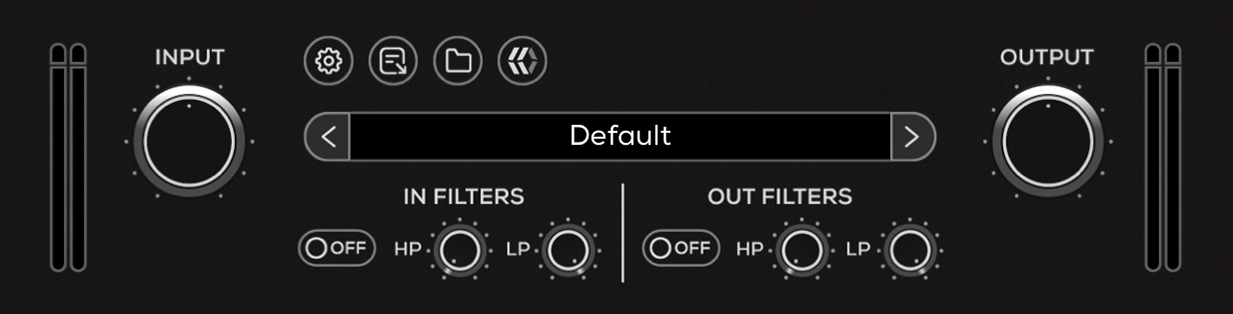
The top section of the plugin includes global controls such as:
Input Gain
Input Filters
Settings
About
Preset Browser
Output Filters
Output Gain
Operational Overview
The Deluxe Memory Man combines analog-style delay with built-in modulation, allowing it to function as both a traditional echo and a movement-based effect.
At its core, the Delay control sets the time between repeats, while Feedback determines how many repeats are heard. Blend balances the dry signal with the delayed signal, shaping how prominent the effect sits in the mix.
The modulation section adds movement to the delay signal. The Chorus–Vibrato switch selects the type of modulation, while the Chorus–Vibrato control adjusts the intensity of that movement. This allows the effect to range from subtle widening to more pronounced pitch-shifting textures.
Short delay times combined with higher feedback can create reverb-like spaces, while longer delay times produce more distinct echoes. Adjusting the delay time during playback introduces pitch-shifting artifacts characteristic of analog delay circuits.
The Overload indicator reflects signal level within the delay circuit but does not function as a strict peak limiter. It may illuminate frequently or remain on during normal use, and this does not necessarily indicate improper gain staging.
Together, these controls allow the Deluxe Memory Man to move beyond standard delay, offering everything from gentle ambience to expressive, modulated textures.
EHX Deluxe Memory Man Controls
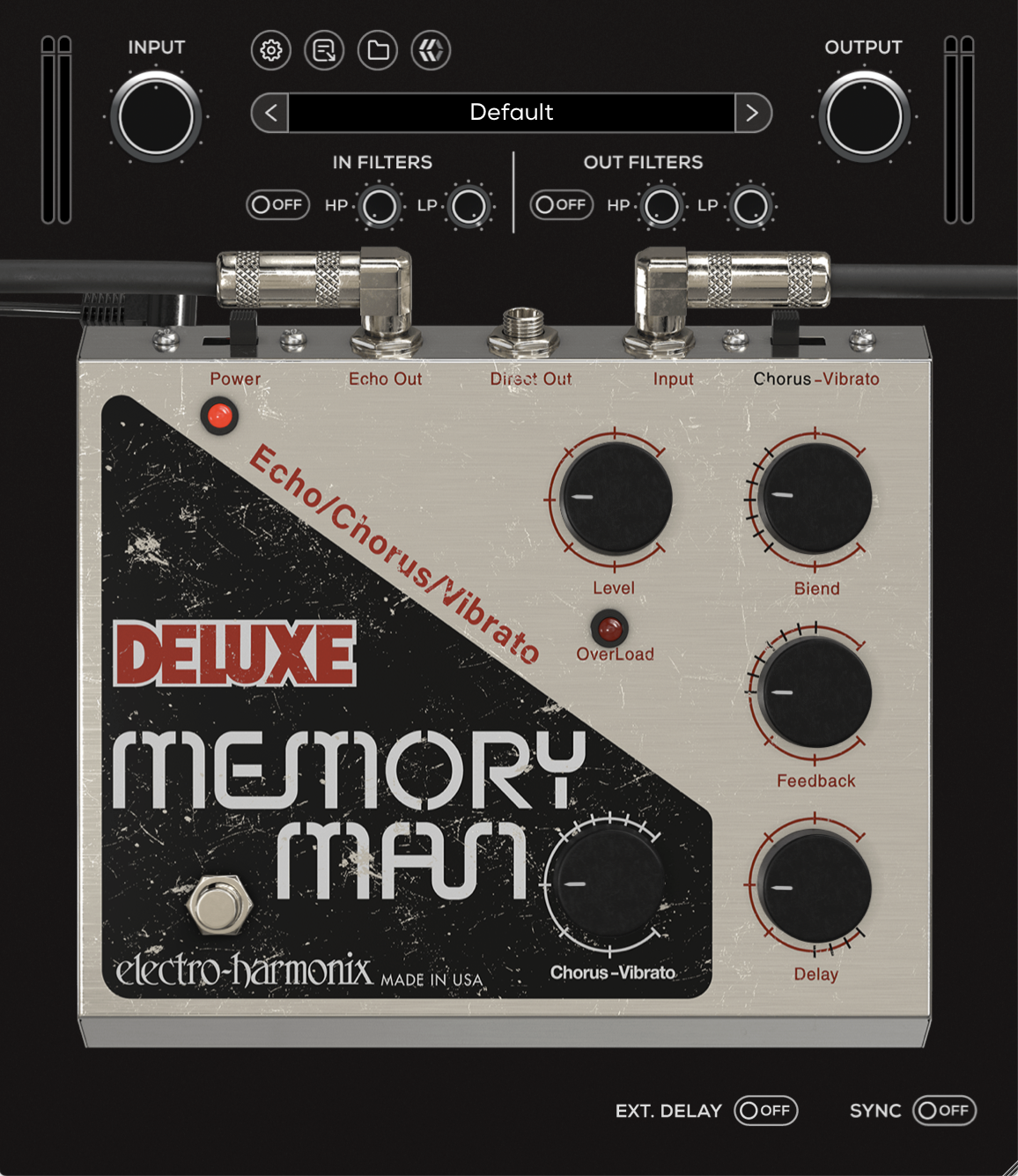
Power
Turns the plugin on or off. When switched off, the signal is fully muted.
Chorus-Vibrato (Switch)
Selects the type of modulation applied to the delay signal.
Chorus produces a smoother, more blended modulation that adds width and movement, while Vibrato introduces a more pronounced pitch variation for a warbling, “Doppler-like” effect.
Level
Controls the input level feeding the delay circuit.
Set this so the signal is strong but not excessively driven. Higher levels will push the circuit harder, introducing additional saturation and potential distortion, while lower levels retain a cleaner response.
Overload
Indicates the signal level before entering the delay stage. The indicator may illuminate frequently or remain on during normal operation and should not be treated as a strict peak warning.
Blend
Adjusts the balance between the dry signal and the delayed signal.
At the center position, both signals are present at equal levels. Lower settings favor the dry signal, while higher settings bring the delay forward in the mix.
Feedback
Controls the number of delay repeats.
Lower settings produce a single echo or short repeats, while higher settings create sustained echoes. At extreme settings, the delay will enter self-oscillation, generating continuous, evolving feedback.
Delay
Sets the time between the original signal and the delayed signal.
Short delay times can create doubling or reverb-like effects, especially when combined with higher Feedback settings. Longer delay times produce more distinct echoes. Adjusting the delay time while audio is playing can introduce pitch-shifting and modulation artifacts characteristic of analog delay circuits.
Chorus-Vibrato (Knob)
Controls the intensity of modulation applied to the delay time.
Lower settings produce subtle movement, while higher settings create deeper, more noticeable pitch variation. The overall character of the modulation depends on whether Chorus or Vibrato mode is selected.
Pedal Bypass
Engages or disengages the pedal circuit.
When bypassed, only the pedal processing is disabled. Global features such as Input and Output filters remain active. To fully bypass the plugin, use the DAW’s plugin bypass control.
Extended (EXT.) Delay
Expands the available delay time range beyond the original hardware limits.
When disabled, the Delay control operates within the classic range of approximately 20 ms to 550 ms, matching the behavior of the original unit. When enabled, the range is extended up to 3000 ms, allowing for longer echoes and more spacious delay textures while retaining the character of the original circuit.
Sync
Synchronizes the delay time to the host DAW tempo.
This allows delay repeats to follow musical note divisions, making it easier to lock echoes rhythmically to a track. When enabled, delay time is determined by tempo-based values rather than free-running milliseconds.